
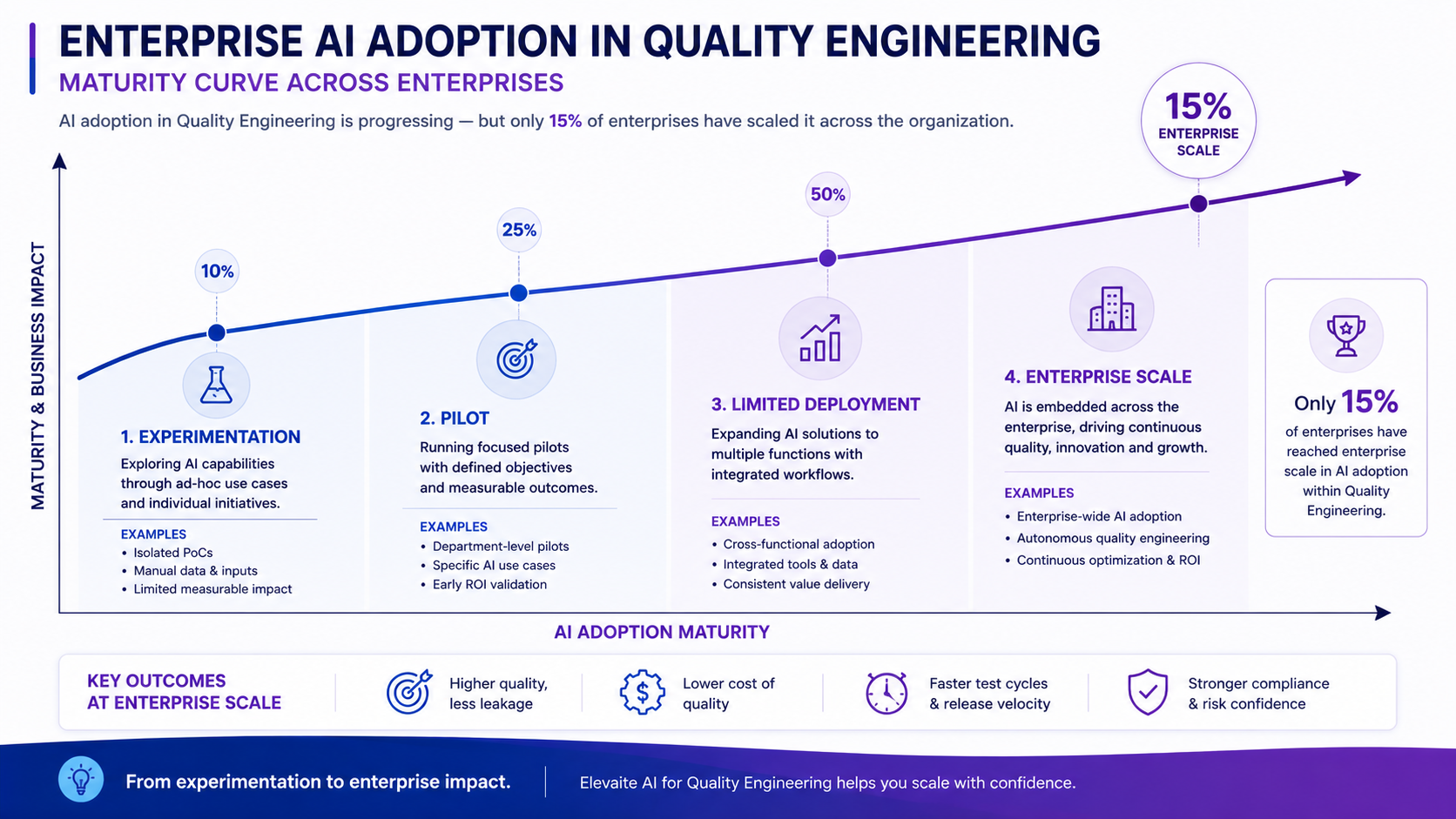
Artificial intelligence is entering the enterprise testing function with significant momentum, and Microsoft Dynamics 365 Finance and Operations environments are not exempt from this shift. Vendors are embedding AI capabilities into testing toolsets, implementation partners are exploring AI-assisted test generation, and executive leadership is being asked with increasing frequency whether their ERP quality assurance practices are keeping pace with the direction of the market.
The question is a reasonable one. AI-augmented testing carries genuine potential for D365 F&O environments: the ability to generate test scenarios at scale, adapt test coverage dynamically to system changes, and reduce the manual effort required to maintain regression suites across complex, multi-module deployments. For organizations managing a continuous update cadence alongside demanding operational obligations, those capabilities address real constraints.
The challenge is that the gap between what AI-augmented testing promises and what it reliably delivers in production ERP environments is currently significant, and the governance implications of that gap are not yet well understood by most finance and operations leaders. Understanding both the opportunity and the risk is the foundation of a responsible evaluation posture.
Key Takeaways
- AI-augmented testing tools are entering the D365 F&O market rapidly, but independent research confirms that enterprise-scale deployment remains the exception rather than the norm, with most organizations still in pilot or experimentation phases.
- Finance and operations leaders need a governance framework for evaluating AI-assisted testing claims that separates capability from readiness, and that accounts for the specific integrity requirements of ERP financial workflows.
- Organizationsthat combine structured automation foundations with selective AI augmentation are better positioned than those pursuing AI-first testing strategies without the underlying process maturity to support them.
Where the AI Testing Market Actually Stands in 2025
The volume of conversation around AI in enterprise testing substantially outpaces the current state of deployment. According to the Capgemini World Quality Report 2025, 89% of organizations are now piloting or deploying generative AI in their quality engineering practices. That figure sounds expansive until the next data point: only 15% have achieved enterprise-scale deployment. The remaining organizations are distributed across pilot phases and limited use cases, with a substantial portion reporting minimal productivity gains despite active investment.
This gap between adoption intent and realized value is not surprising given the complexity of what AI-augmented testing actually requires to work well. Generating useful test cases at scale demands structured, high-quality process data to train on. Adapting test coverage dynamically requires a stable baseline of existing automation to build from. And validating AI-generated test outputs in a financial ERP context requires human subject matter knowledge that cannot yet be automated away. Organizations that are succeeding at enterprise-scale AI testing deployment are almost universally those that already had strong automation foundations in place before introducing AI augmentation.
The Specific Governance Risks of AI Testing in D365 F&O Environments
For D365 F&O specifically, the governance risks of AI-augmented testing deserve careful consideration before adoption decisions are made. The financial workflows that run on D365 F&O, including accounts payable, accounts receivable, general ledger posting, revenue recognition, and regulatory reporting, carry a level of precision requirement that distinguishes them from most other enterprise application contexts.
AI models used in test generation can produce plausible-looking test cases that do not accurately reflect the business logic of a given workflow. In a consumer application context, this produces a suboptimal user experience. In a D365 F&O financial workflow context, it can mean that a test suite passes validation while leaving material process risks undetected, because the tests were generated against a surface-level interpretation of the workflow rather than its actual business intent.
The Capgemini World Quality Report 2025 identifies the top barriers to scaling AI in quality engineering as data privacy risks (cited by 67% of respondents) and hallucination and reliability concerns (cited by 60%). Both of these are acutely relevant in a D365 F&O finance context. Data privacy concerns apply directly to the use of live financial transaction data in AI model training or test data generation. Hallucination risk, where an AI model produces confident but incorrect outputs, is particularly consequential when the output is a test case intended to validate a financial control.
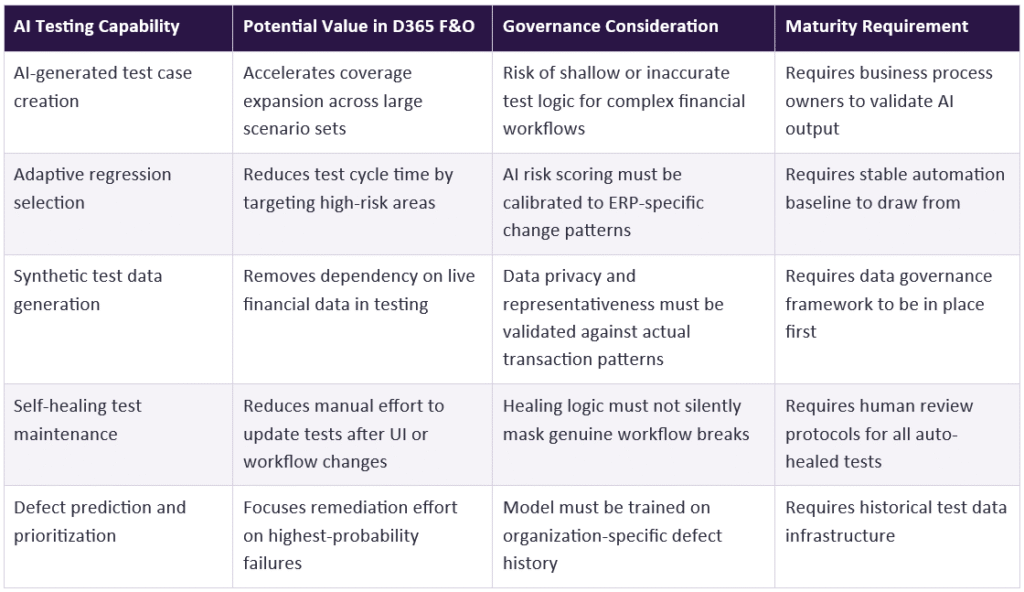
The following table maps the primary AI testing capability claims against their governance considerations in a D365 F&O finance context:
Why Financial Services AI Adoption Makes This Conversation Urgent
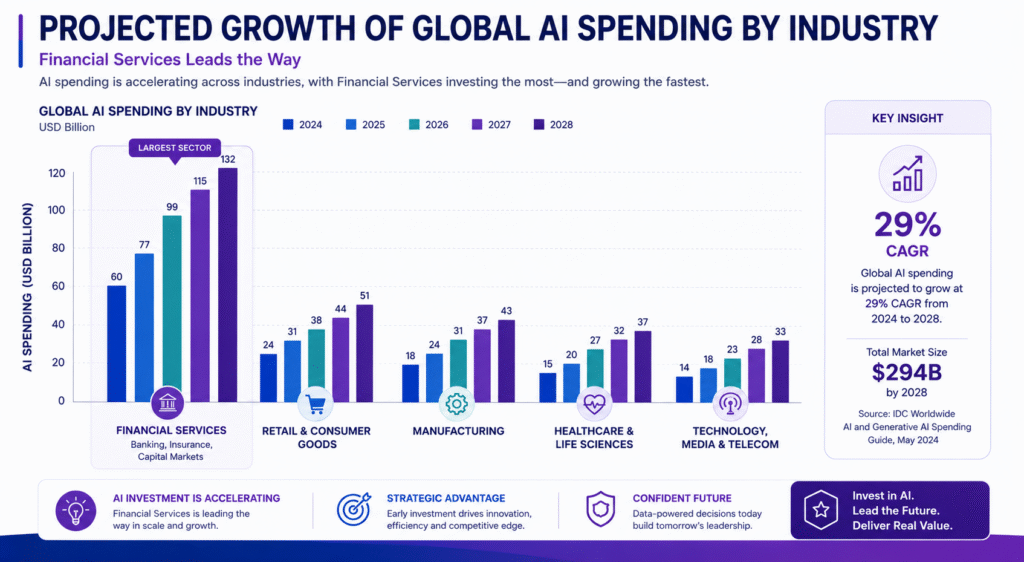
The pace of AI investment in the financial services sector gives this governance conversation urgency. According to IDC’s Worldwide AI and Generative AI Spending Guide, global AI spending is projected to reach $632 billion by 2028, growing at a compound annual rate of 29%. Financial services, with banking leading adoption, is expected to account for more than 20% of all AI spending over that period, making it the single largest industry driver of AI investment globally.
For finance and operations leaders in organizations deploying D365 F&O, this trajectory has two implications. First, the vendor ecosystem around D365 F&O testing is going to become progressively more AI-oriented, meaning that evaluation criteria for testing tools and approaches will need to evolve. Second, as AI-generated outputs become more prevalent across financial workflows, the audit and governance expectations around how those outputs are validated will increase accordingly. Organizations that develop a coherent AI governance posture for their ERP testing function now will be better positioned than those that adopt AI testing tools reactively and build governance frameworks after the fact.
The Foundation That Makes AI Augmentation Work
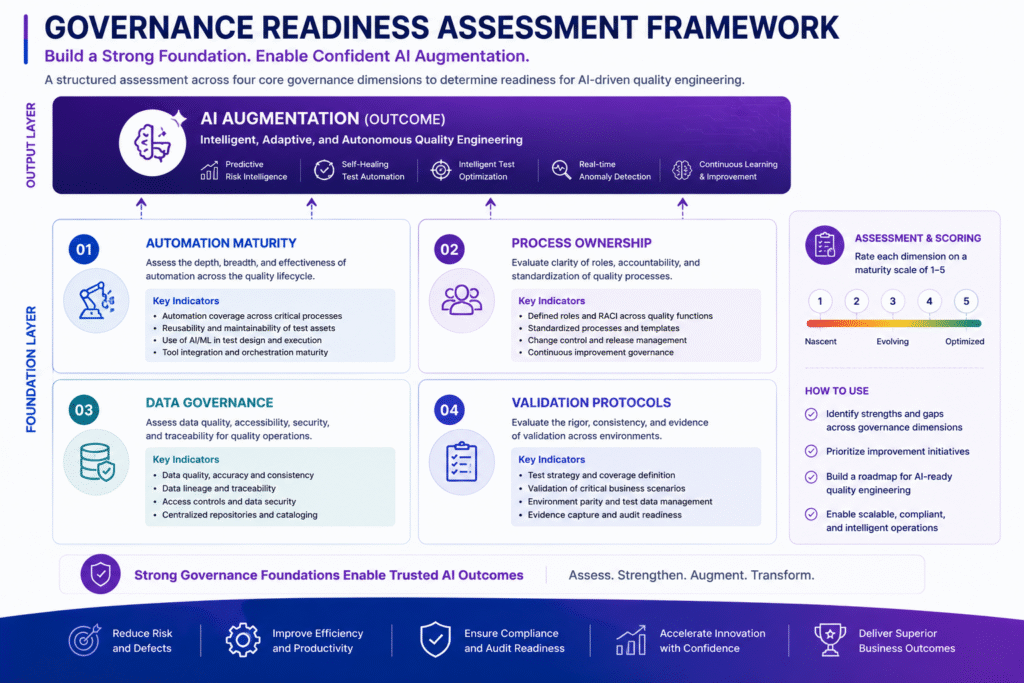
The organizations reporting meaningful productivity gains from AI-augmented testing share a common characteristic: they approached AI as an enhancement to an existing, structured automation practice rather than as a replacement for one. In D365 F&O terms, this means that AI augmentation is most valuable when it is layered on top of a regression test library that already covers the critical paths, a test data strategy that does not depend on live production data, and a process ownership model where finance and operations professionals are involved in validating test coverage, not just IT.
Without these foundations, AI-generated test cases introduce noise rather than signal. They expand the volume of tests without necessarily improving the quality of coverage, and they can create a false sense of assurance that is more dangerous than acknowledged gaps in a manual testing approach.
Elevaite365 Test Automation is designed specifically for the D365 F&O environment and built around the principle that finance and operations users, not technical testers, should own the validation of business process integrity. This approach creates the structured automation foundation that makes AI augmentation meaningful when it is introduced: a test library built by people who understand the workflows, covering the scenarios that actually matter for financial accuracy and compliance, and producing results that finance leadership can interpret without requiring IT translation.
AI augmentation is already part of the platform, applied in a deliberately bounded form: test scripts self-heal when D365 updates change underlying interface elements or workflow paths, removing the maintenance overhead that has historically caused regression libraries to decay between releases. This is a meaningfully different application of AI than generative test case creation, because the AI is operating against a known reference, the existing test, rather than producing test logic from an interpretation of business intent.
That distinction matters for the governance framework above. Self-healing AI that maintains an existing test against interface drift carries a much narrower failure mode than generative AI that produces new tests against an interpretation of business intent. Both can be valuable, but they require different review protocols, different audit trails, and different validation thresholds. Treating them as a single category of capability is one of the more common errors in current AI testing vendor evaluation.
For organizations considering AI-augmented testing capabilities, this foundation isn’t a prerequisite that delays the conversation, but the factor that determines whether AI augmentation delivers measurable value or simply increases complexity.
A Practical Evaluation Framework for AI Testing Claims in D365 F&O
Finance and operations leaders evaluating AI-augmented testing tools for D365 F&O environments should apply consistent criteria that reflect the specific integrity requirements of financial ERP workflows. The questions that matter most aren’t about the sophistication of the AI model, but about how AI outputs are governed, validated, and maintained over time.
A structured evaluation should address the following:
- Whovalidates AI-generated test cases before they enter the regression library? AI-generated tests that haven’t been reviewed by someone with knowledge of the underlying business process amount to a risk rather than a governance
- How does the tool handle test data? Any use of real financial transaction data in AI model training or test generation requires explicit data privacy controls and organizational sign-off that goes beyond the testing function.
- What is the process when AI-generated tests self-heal after a system change? Self-healing that silently absorbs genuine workflow breaks defeats the purpose of regression testing in a financial control environment.
- What automation baseline is required for the AI capabilities to function reliably? Tools that require substantial existing test libraries to generate accurate AI outputs should be evaluated against the organization’s current automation maturity, not its aspirational state.
Conclusion: Governance Before Adoption
AI-augmented ERP testing in Dynamics 365 isn’t a future consideration, but an active market development that finance and operations leaders are already encountering in vendor conversations, implementation partner recommendations, and internal technology roadmap discussions. The governance question is not whether to engage with these capabilities, but how to evaluate them against the specific integrity requirements of financial ERP workflows.
The evidence from independent research is consistent: the organizations achieving enterprise-scale value from AI in quality engineering are those with the process maturity, data governance, and ownership structures to support it. For D365 F&O environments, where the accuracy of financial processes directly affects reporting integrity, audit readiness, and regulatory compliance, those foundations are not optional.
Organizations that build structured, finance-owned automation practices as their first priority, and evaluate AI augmentation against a clear governance framework as their second, are taking the approach most likely to deliver both near-term testing efficiency and long-term ERP integrity. That sequence matters more than the pace of adoption.
Frequently Asked Questions
What does AI-augmented testing mean in a D365 F&O context?
AI-augmented testing refers to the use of generative AI or machine learning capabilities to support testing activities, including generating test cases, selecting which tests to run based on system changes, creating synthetic test data, and automatically updating tests when system interfaces change. In a D365 F&O context, these capabilities are being incorporated into testing tools and platforms that serve ERP environments specifically.
The value proposition is genuine but conditional. AI augmentation can meaningfully reduce the manual effort required to maintain large regression test libraries, expand scenario coverage faster than manual authoring allows, and help organizations keep pace with D365 F&O’s continuous update cadence. The condition is that the underlying automation practice, process ownership model, and data governance framework are sufficiently mature to support AI-generated outputs reliably.
Why is the governance risk of AI testing higher in financial ERP environments than in other application contexts?
Financial ERP workflows require a level of business logic precision that most application contexts do not. A test case that validates a customer-facing UI interaction may be forgiving of minor inaccuracies in how the AI interpreted the scenario. A test case that validates a three-way matching process, a revenue recognition schedule, or a bank payment file output cannot be. The consequences of an inaccurate test aren’t a suboptimal user experience, but a defect that passes validation and reaches production.
This precision requirement means that AI-generated test cases for D365 F&O financial workflows need systematic review by finance and operations professionals who understand the intended behavior of each process, not just technical testers who can confirm that a test executed. Without that review layer, AI augmentation increases test volume without necessarily improving the quality of financial assurance.
How should organizations evaluate vendor claims about AI testing capabilities for D365 F&O?
The most important evaluation criteria aren’t technical, but governance-oriented: how are AI-generated test outputs reviewed and approved before entering the regression library, how is test data governed when AI tools require access to financial transaction data, and what happens when the AI self-healing capability makes an automatic update to a test after a D365 F&O system change. Tools that cannot provide clear, process-level answers to these questions introduce governance risk that should be weighed against the efficiency benefits they offer.
Organizations should also ask vendors for concrete evidence of enterprise-scale deployment in comparable D365 F&O environments, not pilots or proof-of-concept implementations. As the Capgemini World Quality Report 2025 data shows, the gap between piloting AI in testing and achieving enterprise-scale value is substantial, and the vendor’s ability to demonstrate successful deployment at scale in financial ERP contexts is a meaningful signal of whether the capability is mature enough for production use.
What automation foundations should be in place before introducing AI augmentation into D365 F&O testing?
At a minimum, organizations should have a regression test library that covers the critical financial workflows in their D365 F&O environment, a test data strategy that does not rely on live production financial data, a process ownership model where finance and operations professionals are involved in defining and validating test coverage, and a structured change management process that connects testing activities to the D365 F&O update calendar. These foundations determine whether AI augmentation adds genuine value or simply increases the complexity of an already fragmented testing approach.
Organizations that introduce AI testing tools before these foundations are in place typically find that the AI capabilities underperform against vendor projections, because the AI models do not have the structured inputs they need to generate accurate, relevant outputs. Building the foundation first isn’t a delay strategy, but the factor that determines whether AI investment in testing delivers measurable returns.
How will AI change the skills and ownership model for ERP testing in D365 F&O environments?
The most significant skills implication of AI in D365 F&O testing isn’t technical, but interpretive. As AI tools generate more of the test case volume, the human contribution that matters most shifts from test execution and script authoring toward evaluating whether AI-generated tests accurately reflect the business intent of the workflows they are meant to validate. This is a finance and operations competency, not an IT one.
For organizations building their ERP testing governance posture with this shift in mind, the implication is that finance and operations professionals need to be positioned as active participants in test validation, not passive recipients of IT-generated test results. The organizations that will extract the most value from AI-augmented testing in D365 F&O are those that invest in this ownership model alongside the technology, because the technology cannot compensate for the absence of business-level judgment in a financial ERP context.
A note on statistics used in this article:
- All Capgemini World Quality Report 2025 figures (89% adoption, 15% enterprise scale, 67% data privacy concerns, 60% hallucination concerns) are sourced from the PRNewswire press release published November 13, 2025. Capgemini is an independent global consulting and research firm. The report is co-published with OpenText and Sogeti and is based on primary survey research. The PRNewswire link is ungated.
- The IDC AI spending figures ($632 billion by 2028, 29% CAGR, financial services as largest sector) are sourced from the Computerworld summary of the IDC Worldwide AI and Generative AI Spending Guide, August 2024. IDC is an independent analyst firm. The Computerworld link is ungated.