
The Microsoft partner ecosystem has matured into one of the largest commercial channels in enterprise technology. With hundreds of thousands of professionals certified across the Dynamics 365 portfolio and competition for customer engagements at a high, the dimensions that historically separated leading ISVs and implementation partners have become baseline. Technical depth, vertical expertise, and Microsoft Solutions Partner designations are now expected rather than differentiating.
What is differentiating in 2026 is more structural: the demonstrated ability to handle the recurring risk and operational complexity that comes with the continuous-update D365 model. Customers signing multi-year contracts with Microsoft Partners are asking pointed questions about quality engineering, and the answers they receive are shaping competitive shortlists in ways that did not exist three years ago.
The Microsoft Partner Quality Engineering Playbook for 2026 has moved past the question of whether to invest in this capability and into the practical work of building it, packaging it, and presenting it as a strategic part of the partner relationship. The partners getting this right are positioned to win competitive deals, command higher engagement value, and reduce the operational drag that follows poorly tested D365 deployments into production.
Key Takeaways for Executive Leadership
Before examining the underlying dynamics, several implications stand out:
- Qualityengineering capability is becoming a structural differentiator in the Microsoft Partner ecosystem, particularly for D365 ISVs serving regulated and high-volume customers.
- Customersare increasingly evaluating partners on demonstrable testing methodology and audit-ready documentation, not just product knowledge or implementation experience.
- Partnersthat integrate test automation into their service portfolio early are positioned to win competitive deals, command higher engagement value, and reduce post-go-live remediation costs.
Why Quality Engineering Has Become a Microsoft Partner Differentiator
Two shifts are happening at once in the Microsoft Partner ecosystem. The customer base is more sophisticated about ERP implementation risk, and Microsoft has restructured partner recognition through the Solutions Partner framework to reward measurable performance outcomes rather than just certifications and revenue volume.
Against this backdrop, research from Gartner forecasts that by 2027, more than 70% of recently implemented ERP initiatives will fail to fully meet their original business goals, with as many as 25% failing catastrophically. For Microsoft Partners selling D365 implementations, this is not an abstract statistic. Customers reading the same research are asking partners to explain how they manage that risk in practice, and the credible answer increasingly involves quality engineering practices that extend well beyond traditional UAT.
What D365 Customers Are Asking Their Partners About Testing
Customer evaluation criteria have changed in detectable ways over the past 24 months. Procurement teams and IT leadership are asking for evidence of repeatable test methodology, scenario coverage standards, and post-go-live validation processes that produce audit-defensible documentation.
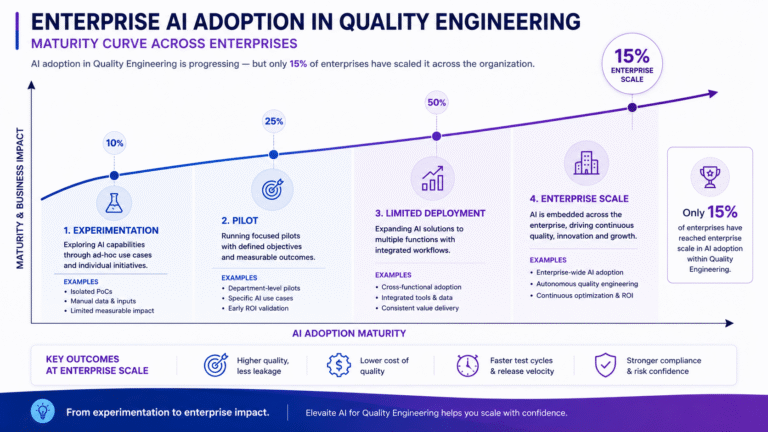
The shift is being driven by hard-won lessons from earlier ERP programs and by independent research framing quality engineering as a strategic enterprise capability. The Capgemini World Quality Report 2025 found that while 89% of organizations are pursuing generative AI in quality engineering, only 15% have achieved enterprise-scale deployment. That 74-point gap between intent and execution is not only a customer challenge, but a signal that customers are looking for partners who can credibly close it.

Where Microsoft Partners Win or Lose on D365 Implementation Quality
The competitive question for partners is not whether to invest in quality engineering capability but where to invest, and how visibly. The following table outlines dimensions where customers are increasingly comparing partners during the evaluation phase:

The dimensions on the right side of this table are increasingly what differentiated partners demonstrate during competitive evaluations, and what customers are willing to pay a premium to access.
How Forward-Looking D365 Partners Are Operationalizing Quality Engineering
Partners building credible quality engineering practices share several characteristics. They treat test automation as part of the implementation service rather than a separate workstream. They maintain a library of pre-built D365 test scenarios that accelerate engagement startup. They document testing as part of the change management record, which positions them well in audit conversations. They invest in capabilities like self-healing automation that maintain regression coverage across Microsoft’s continuous update cadence without requiring constant manual rework.
The talent dimension is also visible. The same Capgemini research found that 50% of organizations cite a lack of AI and quality engineering expertise as a barrier to scaling, unchanged from the previous year. This talent scarcity creates an opening for Microsoft Partners who can offer quality engineering capability as a service rather than asking customers to build it themselves.
How Elevaite365 Supports Microsoft Partner Quality Engineering

For partners building quality engineering as a competitive capability, the operational question becomes whether to develop test automation tooling internally or partner with a specialist who has already built it. The trade-off is one of speed to market and credibility.
Elevaite365 was built specifically to support this dimension of the Microsoft Partner ecosystem. Through the Elevaite365 partner program, Microsoft Partners gain access to test automation capabilities purpose-built for D365 environments, including AI-driven test maintenance and direct migration paths from Microsoft’s RSAT tool. The intent is not to replace partner expertise but to provide the underlying capability that lets partners present a credible, repeatable quality engineering practice without building the platform themselves.
Quality Engineering as a Strategic Microsoft Partner Capability
Microsoft Partner differentiation in 2026 is being determined less by what the partner sells and more by how the partner manages risk on behalf of the customer. Quality engineering sits at the intersection of those two questions, which is why it is moving from a service-line consideration to a strategic capability conversation. The partners who treat it accordingly will define the competitive landscape for the next several years.
For ISVs and implementation partners building toward this position, the practical move is to start now. The talent gap is real, the customer expectation is rising, and the platform support to operationalize a credible quality engineering practice is available. Partners who invest ahead of the broader market will compound the advantage. Those who wait will find themselves explaining to procurement committees why their methodology resembles the previous decade.
Frequently Asked Questions
Why has quality engineering become a Microsoft Partner differentiator in 2026?
Quality engineering has become a differentiator because technical certifications and vertical expertise are now baseline expectations rather than competitive advantages. Customers are paying closer attention to how partners manage implementation risk and continuous-update complexity, and quality engineering is the most visible answer to those questions.
This shift is reinforced by Microsoft’s Solutions Partner framework, which rewards measurable performance outcomes, and by independent research showing that ERP implementation failure rates remain high enough to make risk management a procurement-level concern in any competitive D365 deal.
What are D365 customers asking partners about quality engineering during evaluations?
Customers are asking for evidence of repeatable testing methodology, scenario coverage standards, and audit-defensible documentation of pre-go-live validation. These questions appear in RFPs and competitive evaluations more frequently than even two years ago.
Partners that cannot answer them concretely tend to be screened out earlier in the process. The most credible answers reference specific testing tooling, named methodologies, and prior customer engagements where the partner can demonstrate the approach in practice rather than describe it in the abstract.
What is the difference between traditional UAT and partner-led quality engineering for D365?
User acceptance testing validates new functionality introduced as part of a project. Partner-led quality engineering covers a broader scope including pre-update regression testing, audit-defensible documentation, and structured scenario coverage that extends across the lifecycle of the customer relationship.
The distinction matters because customers running D365 in production face quality risks well beyond the initial implementation. Partners who can address that lifecycle of risk command higher engagement value than those who treat testing as a one-off project activity.
How does AI fit into Microsoft Partner quality engineering practices?
AI augmentation in quality engineering is real but uneven. Self-healing test scripts that adapt to D365 interface changes are the most operationally mature application, while generative AI for test case creation remains in earlier-stage adoption with significant governance considerations.
Forward-looking partners are integrating bounded AI capabilities while maintaining human review of generated test outputs, particularly for financial workflows where precision is non-negotiable and auditor expectations are highest.
What should Microsoft Partners look for when building a quality engineering capability?
Partners should evaluate whether to build internally or partner with a specialist, considering speed to market, depth of D365-specific scenario coverage, and the ability to support customers through Microsoft’s update cadence without significant manual overhead.
The most efficient path for many partners is to combine their implementation expertise with a purpose-built test automation platform, presenting a quality engineering practice that is credible from day one rather than waiting for internal capability to mature over multiple engagements.
A note on statistics used in this article:
- The Gartner ERP forecast figures (more than 70% of recently implemented ERP initiatives failing to meet original business goals by 2027, with 25% failing catastrophically) are sourced from Gartner research on ERP initiatives. Gartner is an independent technology research and advisory firm.
- The Capgemini World Quality Report 2025 figures (89% of organizations pursuing generative AI in quality engineering, 15% achieving enterprise-scale deployment, 50% reporting an AI and quality engineering expertise gap) are sourced from the report co-published by OpenText, Capgemini, and Sogeti, based on primary survey research with industry leaders. Capgemini is an independent global consulting and research firm.