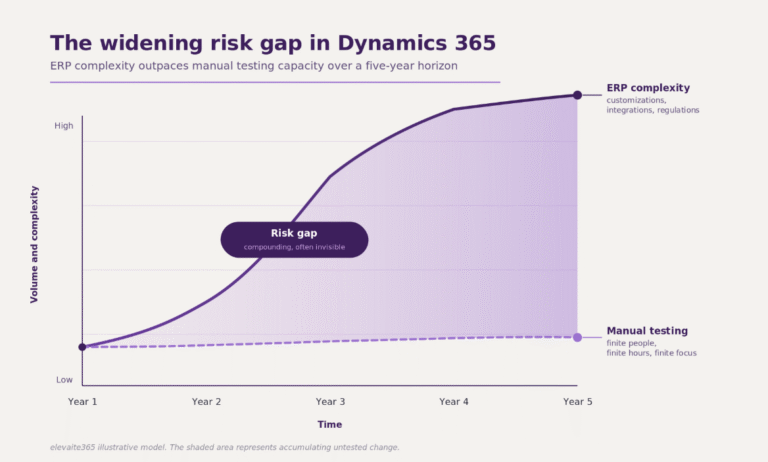
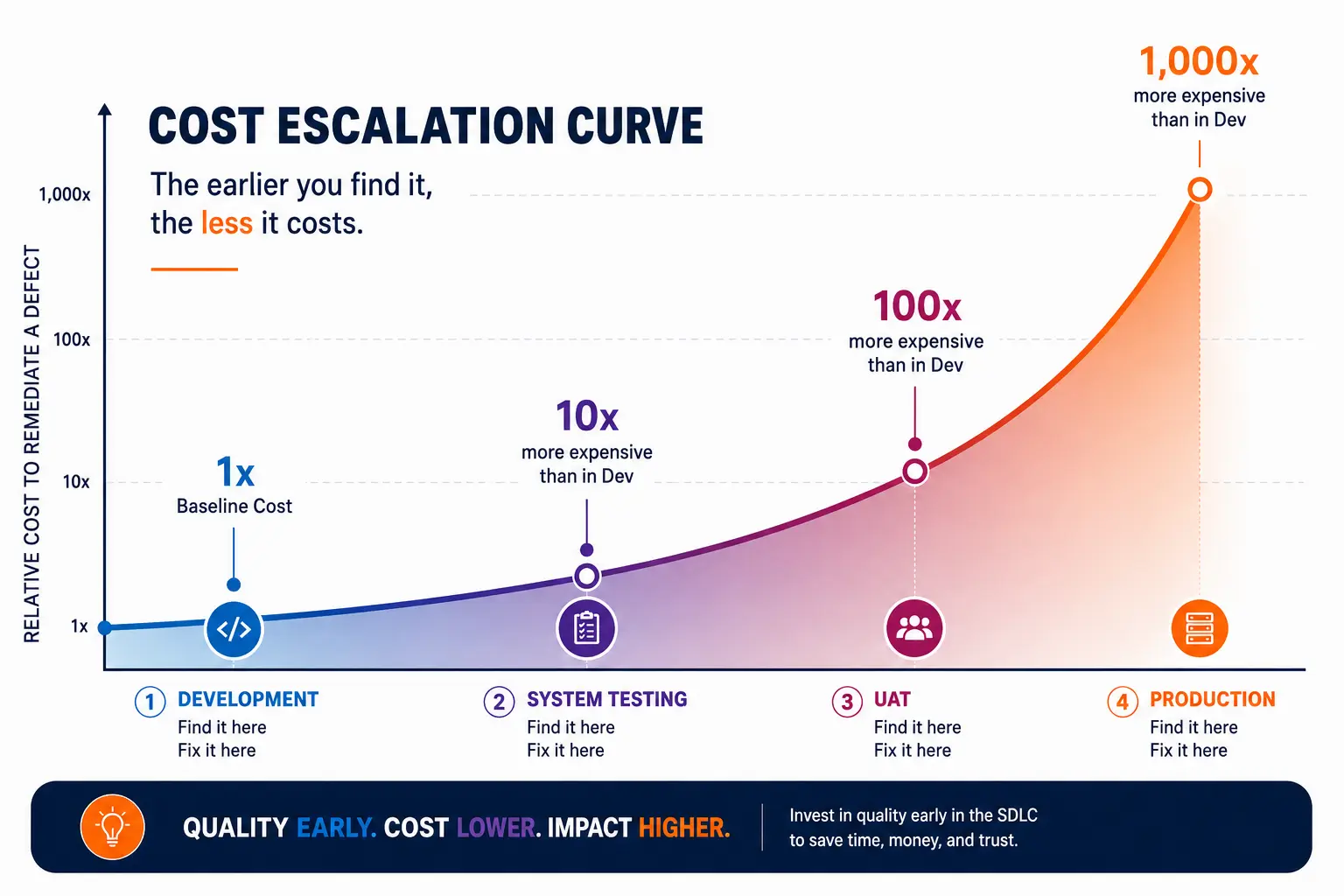
The cost of fixing a software defect rises sharply once it enters production. A defect found in development can be remediated against synthetic data in a controlled environment, but the same defect surviving into production has to be diagnosed against live transaction data, often while the affected process is still running.
Industry research consistently shows that remediation costs increase substantially the later defects are identified. Research from IBM’s Systems Sciences Institute, widely cited in industry analyses, indicates that defects resolved after release can cost between 15 and 100 times more than those addressed earlier in the lifecycle, depending on which stage the comparison starts from. In D365 ecosystems, where business processes and data models are tightly interconnected, late-stage fixes require broader coordination, more extensive validation, and greater governance oversight.
Organizations that control these costs do so through early, systematic risk detection. Enterprise-grade test automation enables teams to validate critical workflows before deployment, keeping remediation predictable and contained. In practical terms, every defect prevented before release avoids what can effectively become a 100x cost multiplier once the issue reaches production.
For executive leaders responsible for cost discipline and governance, test automation functions as both a quality assurance mechanism and a governance control that supports long-term cost discipline.
Executive Takeaways
- Production defects are expensive because they trigger operational disruption, compliance exposure, and emergency resource allocation.
- Test automation reduces remediation costs by identifying issues earlier in the lifecycle, before they impact live ERP operations.
- In D365 environments, automated testing protects accuracy, security, and cost control across interconnected business processes.
Why Production Fixes Become Exponentially More Expensive
When a defect is discovered in development, remediation is typically contained. The environment is controlled, users are unaffected, and data integrity is preserved.
In production, the same issue becomes materially more complex. Organizations must:
- Reproduce the defect in live-like conditions
- Allocate emergency developer resources
- Conduct extensive regression testing
- Manage stakeholder communication
- Address user-facing disruption
Emergency resource allocation alone can multiply costs. Developers are diverted from planned initiatives, creating delays and opportunity cost across the organization.
The broader impact extends further. Production issues may affect customers, financial transactions, compliance workflows, and reporting accuracy. Support volumes increase, and executive attention shifts to incident management.
Debugging is also more difficult in live environments, where systems are integrated and reproduction conditions are less predictable. Fixes must be validated carefully to avoid secondary failures.
Test automation reduces this exposure by validating workflows and integrations earlier in the lifecycle, preventing defects from reaching the stage where costs escalate most sharply.
D365 and ERP Complexity Magnify Production Risk
Current ERP platforms such as D365 operate as integrated ecosystems. Finance, procurement, supply chain, compliance, and analytics share common data models and business logic.
This interdependence means that a defect rarely remains isolated. A validation failure in accounts payable may distort financial reporting. An integration error may compromise tax calculations. A workflow misconfiguration may bypass approval controls.
Manual testing struggles to scale in this context. It’s difficult to repeatedly validate cross-module processes, regression scenarios, and custom integrations without introducing human error.
Test automation enables organizations to:
- Validate end-to-end ERP workflows consistently
- Execute regression suites across releases
- Verify integration stability
- Protect customized business logic
By embedding automated testing into D365 lifecycle management, organizations control complexity rather than reacting to it after deployment.
Compliance, Accuracy, and Security: Hidden Cost Drivers
The cost of production defects extends beyond technical remediation. It directly affects compliance, data accuracy, and security posture.
In regulated industries, organizations must demonstrate:
- Process traceability
- Financial accuracy
- Access control integrity
- Audit readiness
- Data protection safeguards
When defects alter transaction logic or reporting outputs, these assurances are weakened. Remediation may require documentation updates, audit explanations, and retroactive corrections.
Data integrity risk is particularly costly. Fixing issues in live ERP databases often requires careful data cleanup, migration, or reconciliation processes. These activities consume both technical and finance resources, increasing total remediation cost.
Security exposure also increases when defects bypass validation controls. Unauthorized access paths, logging failures, or integration gaps can remain undetected until an incident occurs.
Test automation reduces these risks by continuously validating compliance-critical controls, access configurations, and data processing logic before release. This strengthens governance and prevents costly downstream exposure.
Cost Control Through Shift-Left Test Automation
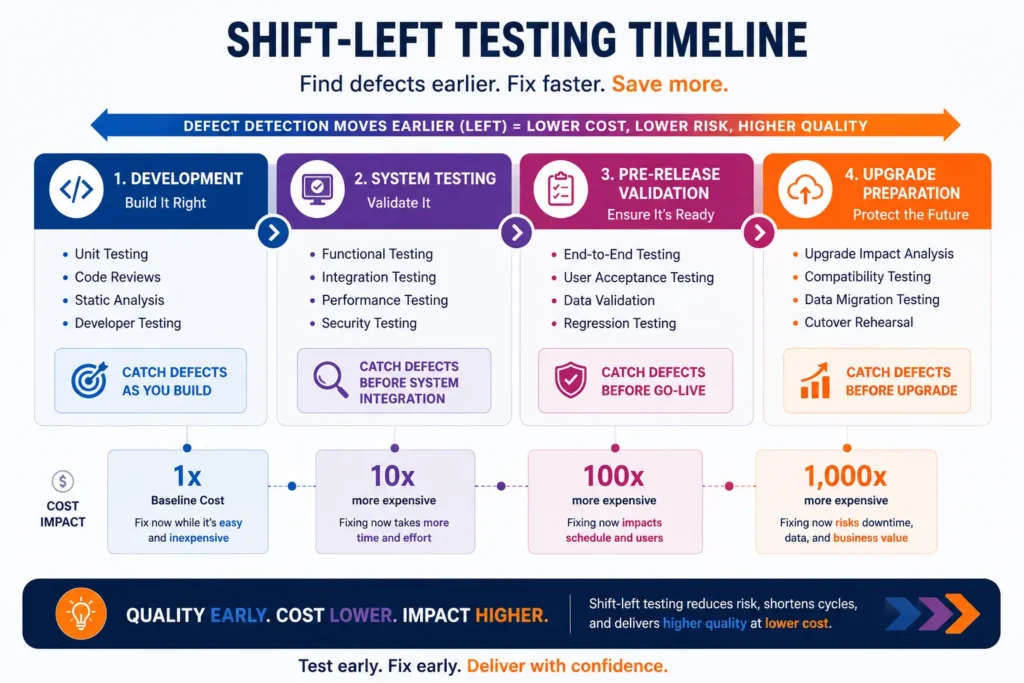
The concept of shift-left testing emphasizes identifying defects earlier in the development lifecycle. The longer a defect remains undetected, the more expensive it becomes to fix.
Test automation operationalizes this principle.
Automated validation allows teams to detect failures during:
- Development
- System testing
- Pre-release validation
- Upgrade preparation
By identifying defects before deployment, organizations replace emergency remediation with planned correction.
At a broader level, this shift is critical. Estimates suggest that poor software quality costs the global economy approximately 2.4 trillion USD annually, largely due to failures, rework, and production defects. Production issues in enterprise platforms like Dynamics 365 contribute directly to this economic burden, meaning that reducing escaped defects through automation lowers an organization’s share of that cost.
The following table illustrates how detection timing influences cost structure across the defect lifecycle.
Defect Cost Escalation by Detection Stage
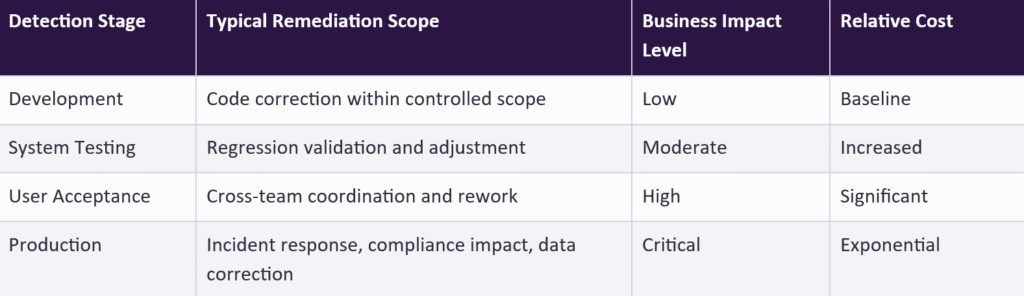
Without structured test automation, organizations increase the probability that defects are discovered in the highest cost stage. With automation, detection shifts earlier, cost remains controlled, and efficiency improves.
Embedding Test Automation into ERP Governance
Effective test automation must align with enterprise governance frameworks rather than function as a standalone QA initiative.
Leading organizations integrate automation into:
- Change management processes
- Release governance boards
- Risk management models
- Compliance reporting structures
In D365 environments, this ensures that configuration updates, feature releases, and integrations are validated against operational and regulatory requirements before going live.
Elevaite365 approaches test automation from this governance perspective. Rather than focusing narrowly on scripts or tools, the emphasis is on protecting business-critical ERP processes, ensuring that automation frameworks support efficiency, accuracy, and long-term cost control.
In D365 environments specifically, the durability of this discipline depends on whether the automation library remains reliable over time. Regression suites that require manual rework after every interface or workflow change tend to absorb the productivity gains they originally promised. The longer-running cost benefit of shift-left automation is typically realized by organizations whose test scripts adapt automatically to interface drift between releases, rather than degrading and requiring reauthoring with each major update. This approach transforms testing from a technical checkpoint into a strategic control layer.
Efficiency Gains Beyond Cost Reduction
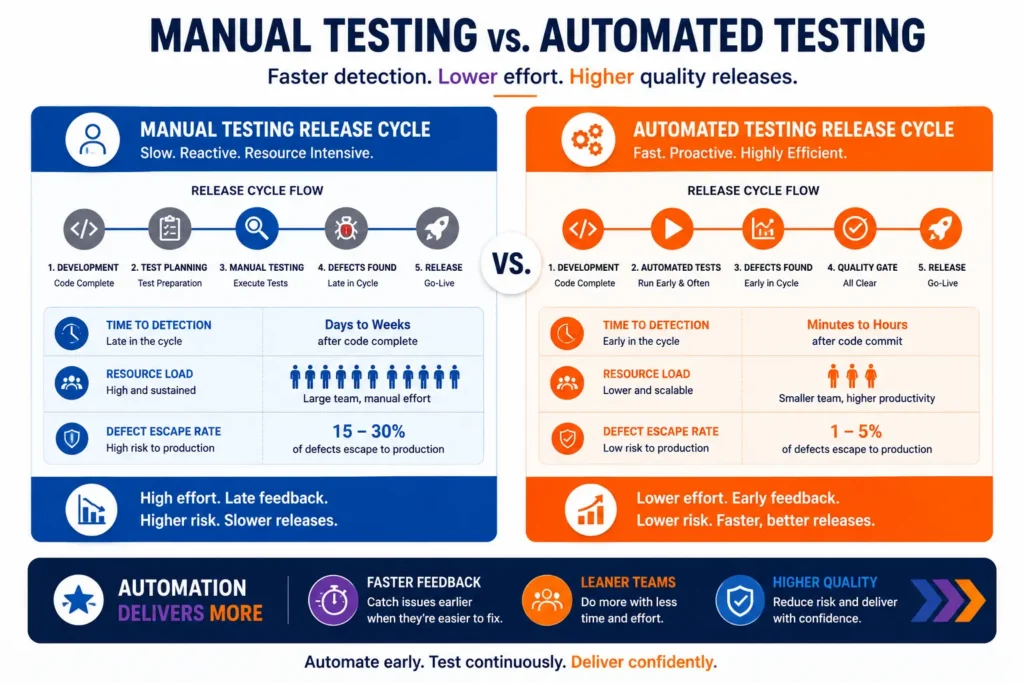
While cost prevention is a primary driver, efficiency improvements follow naturally from structured automation.
When automated regression testing is reliable:
- Release cycles become more predictable
- Manual testing effort decreases
- Human error is reduced
- Teams focus on innovation rather than firefighting
In addition, organizations that adopt automated testing approaches report reductions of 50 to 90 percent in the time required to detect and resolve defects. In a D365 context, this means that when issues do occur, they are identified faster, diagnosed more efficiently, and contained before they escalate into prolonged disruptions.
Operational leaders gain confidence in system stability. Finance teams trust reporting outputs, and compliance teams maintain audit readiness without reactive remediation cycles.
In this way, test automation strengthens both operational efficiency and executive confidence.
Test Automation as a Strategic Cost Containment Mechanism
The high cost of fixing software issues in production isn’t inevitable, but the result of delayed defect detection, fragmented validation processes, and insufficient governance integration.
In D365 and ERP environments, production defects affect financial integrity, compliance exposure, security posture, and organizational credibility. Once live, remediation becomes complex, disruptive, and expensive.
Test automation changes the economics of this equation. By shifting validation earlier in the lifecycle, organizations reduce emergency intervention, protect data accuracy, strengthen compliance, and maintain disciplined cost control.
For executive leaders, the question isn’t whether testing is necessary, but whether testing is structured in a way that prevents production risk rather than reacting to it. Organizations that embed enterprise-grade test automation into ERP governance position themselves for sustainable efficiency and long-term stability.
FAQs
Why are software defects more expensive to fix in production?
Production fixes require emergency resource allocation, extensive regression testing, and cross-functional coordination. They often affect real users and live financial data.
This combination of urgency and business impact drives cost significantly higher than defects resolved during development.
How does test automation reduce ERP remediation costs?
Test automation detects defects earlier, when correction remains localized and controlled. It reduces the likelihood of emergency hotfixes and live system disruption.
By validating workflows consistently, automation prevents issues from reaching the most expensive remediation stage.
Is test automation relevant for D365 upgrades?
Yes. D365 updates frequently introduce changes that may affect customizations and integrations. Automated regression testing ensures that upgrades do not introduce new defects.
This reduces upgrade-related downtime and protects operational continuity.
How does automation improve compliance and accuracy?
Automated test suites validate control points, approval workflows, and financial calculations consistently. This strengthens traceability and audit readiness.
By preventing data inconsistencies before release, organizations protect reporting accuracy and regulatory standing.
Can automation fully replace manual testing?
Automation complements manual testing but does not eliminate it. Exploratory and usability testing still benefit from human insight.
However, for regression, integration, and compliance validation, automation provides consistency and scalability that manual testing cannot match.
A note on statistics used in this article:
- The defect cost escalation benchmark (15x to 100x depending on which lifecycle stage the comparison starts from, with production versus system testing at the lower end and production versus early development at the upper end) originates from research by IBM’s Systems Sciences Institute and is widely cited in industry analyses of software quality. While this figure dates from earlier software development contexts, it remains one of the most consistently referenced benchmarks in enterprise software quality management.
- The estimate that poor software quality costs the global economy approximately $2.4 trillion USD annually is sourced from the Consortium for Information & Software Quality (CISQ) and Synopsys research. This figure encompasses operational software failures, legacy system issues, technical debt, and defect-related rework across global software systems.
- The reported 50 to 90 percent reduction in defect detection and resolution time with automated testing approaches is drawn from industry benchmarks and practitioner case studies rather than a single named source. Results vary by organization, testing maturity, and implementation approach.