Microsoft Dynamics 365 underpins some of the most critical financial, operational, and compliance processes across modern enterprises. For CIOs, CFOs, and compliance leaders, the integrity of every financial close, procurement decision, revenue posting, and regulatory filing depends on what runs inside the platform.
As a result, every system update has direct implications for operational stability and organizational credibility. Despite this, many organizations still rely heavily on manual validation processes. Business users execute test scripts; QA teams log results in spreadsheets, and release decisions are often based on partial validation and constrained timelines, with updates pushed forward to meet operational demands.
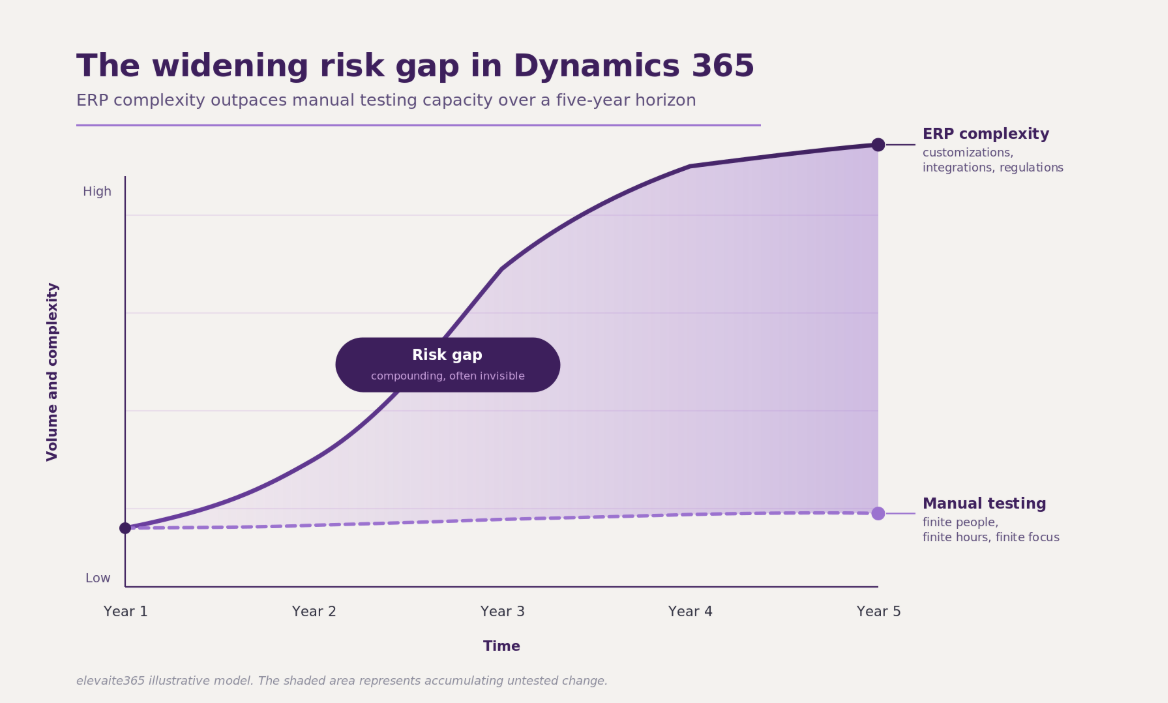
This approach may reflect experience and familiarity, but it no longer matches the complexity of current ERP environments. Manual testing introduces structural risk that compounds over time, placing increasing pressure on individuals to validate systems that have outgrown consistent human oversight.
Key Takeaways for Executive Leadership
Before examining root causes, several implications stand out:
- Manual testing introduces cumulative and often invisible financial and compliance risk
- Human-led validation does not scale with modern ERP complexity
- Automation strengthens internal controls and audit defensibility
Why Manual Testing Still Dominates in Business-Critical Systems
Manual testing persists most likely because it feels tangible and controllable. It gives leadership a sense of oversight and leverages institutional knowledge.
Many organizations still operate on a set of assumptions that have not aged well: that business users understand workflows better than automated systems and can therefore validate them more reliably, that manual validation more closely reflects real-world usage, and that automation is inherently complex, expensive, or too brittle to maintain over the long term. Each of these assumptions had merit in earlier ERP environments, but none survives close inspection in the current generation of D365 deployments, where the volume and interdependence of workflows have moved beyond what consistent human attention can cover.
Current data, however, challenges these assumptions.
According to the State of Testing 2024 report, only 2 percent of organizations report that automation has fully replaced manual testing. Meanwhile, 18 percent say they have automation that has not replaced any manual work, and 9 percent operate without any automation at all.
The vast majority of organizations continue to rely heavily on manual processes for regression testing, particularly across the repeat validation cycles tied to Dynamics 365 updates. Each update cycle becomes another opportunity for human error to compound and for defects to slip through unnoticed.
How Manual Testing Produces Defect Leakage
When issues reach production, they’re often attributed to individual mistakes. In reality, most stem from systemic limitations.
Manual regression testing requires sustained focus across complex configurations, dependencies, and datasets. Over time, fatigue reduces accuracy. Even well-defined scripts leave room for interpretation, particularly under time pressure.
The structural challenges compound. Test data preparation is fragile and time-consuming, particularly across multi-entity D365 environments where realistic scenarios depend on coordinated reference data. Documentation tends to lag behind system changes, so test scripts often describe a previous version of the workflow rather than the current one. Release windows are tight, leaving teams with the choice of trimming coverage or extending timelines. None of these are individual failings. They’re predictable consequences of validating a continuous-update enterprise platform with capacity that doesn’t scale at the same rate. These constraints make inconsistency unavoidable. Human error isn’t an anomaly, but more of an expected outcome of the process.
The risks associated with manual testing are well documented in software engineering research. Guidance on defect leakage highlights that reliance on manual testing often leads to incomplete coverage, skipped steps, and missed defects due to human limitations. In the context of Dynamics 365, this has direct financial consequences.
Every defect that escapes detection during a release can translate into:
- Revenue leakage
- Incorrect financial postings
- Write-offs and rework
- Increased support and remediation costs
In effect, each undetected defect moves risk directly onto the balance sheet.
The Financial and Compliance Cost of Testing Failures
Independent ERP research reinforces the connection between testing quality and business outcomes.
Panorama Consulting Group’s 2024 ERP Report shows that:
- Only 46.4 percent of ERP implementations are delivered on budget
- Just 6.6 percent come in under budget
Most exceed planned costs, often significantly.
The same research highlights widespread schedule delays and operational disruption during and after go-live. These challenges are frequently linked to weaknesses in testing, validation, and change management.
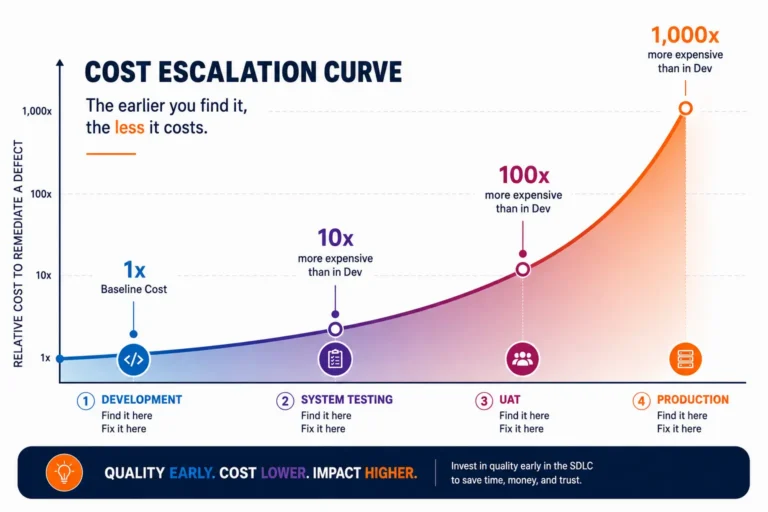
For organizations running complex Dynamics 365 environments, fragmented and manual testing produces a recognizable pattern. Defects surface late, often in production rather than in earlier validation stages, which drives remediation costs significantly higher than they would have been if caught during testing. Each cycle of late discovery further erodes confidence in system reliability, both within the operations function and at the executive level where decisions about further D365 investment are made.
Budget overruns and delays are therefore not isolated execution issues. They’re often downstream effects of insufficient validation. From this perspective, manual testing isn’t merely a quality concern, but a measurable driver of financial variance and operational risk.
At an executive level, testing failures represent governance failures.
When defects pass through manual validation, the consequences extend across functions. Financial inaccuracies undermine reporting integrity and expose organizations to restatement risk and audit findings. Incomplete audit trails complicate compliance reviews, particularly in regulated industries where evidence of control execution is itself a control. Operational disruption delays month-end close, customer commitments, and supplier relationships. Stakeholder confidence erodes, and broader transformation initiatives slow because each is shadowed by the perceived risk of repeating the same testing failures. Over time, the cost of remediation and reputational damage often exceeds the investment required to modernize testing practices.
Manual vs Automated Testing in Governance-Critical Environments
For leadership, the distinction between manual and automated testing isn’t technical, but structural.
The following table illustrates the key differences across dimensions that matter most to compliance and risk functions:
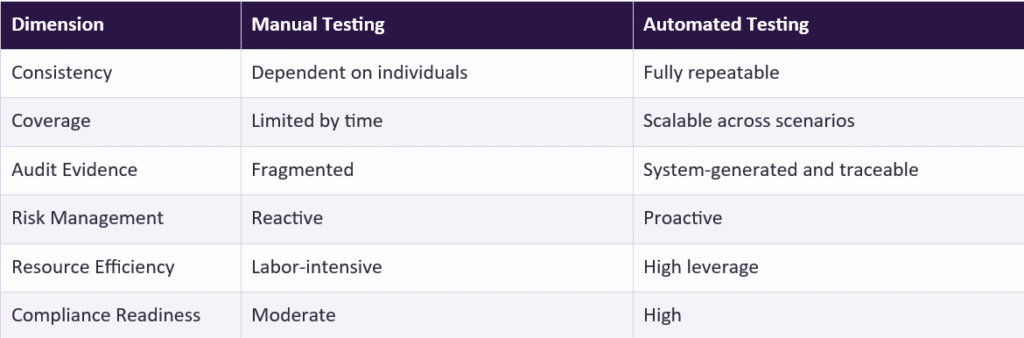
In this context, manual testing increasingly conflicts with enterprise risk management priorities.
Test Automation as a Governance Capability
Test automation is often positioned as an IT initiative, but it’s actually a governance capability.
For finance and IT leadership, what test automation enables is structurally different from what it has historically been positioned to do. It produces objective validation of business processes that does not depend on individual judgment, continuous monitoring of system integrity, and evidence-based release approvals that satisfy both internal change management and external audit expectations. Audit defensibility strengthens, operational predictability improves, and quality assurance shifts position in the operating model, becoming part of the internal control framework rather than a supporting function that runs alongside it.
How Elevaite365 Strengthens Risk Governance
Many automation tools focus on surface-level interactions rather than business outcomes. In Dynamics 365 environments, that approach provides limited assurance.
Elevaite365 Test Automation is designed to validate the business processes that run on D365, across the modules and integrations each organization depends on, from finance and operations to supply chain, sales, and customer service.
The capability set centers on end-to-end process validation aligned with operational workflows rather than narrow technical interactions. Regression testing is repeatable, which lets organizations establish reliable baselines and measure whether system behavior has shifted across releases. Test data is structured rather than ad hoc, producing the audit evidence internal and external auditors increasingly request. Executive dashboards provide visibility into coverage, defects, and residual risk, in formats finance and compliance leadership can interpret directly. Test scripts self-heal as D365 interfaces change between updates, which is what keeps an automation library useful across release cycles rather than degrading into maintenance overhead.
By aligning testing with compliance and internal control frameworks, Elevaite365 elevates quality assurance into a governance function.
Organizations that reduce reliance on manual testing achieve more than fewer defects. System updates become faster to absorb because validation is no longer the rate-limiting step in the release. Financial operations become more predictable because the workflows that touch reporting integrity are validated against a consistent baseline. Audit friction reduces because the testing record is structured and traceable rather than reconstructed from email and memory. The cumulative effect is a measurably stronger return on the ERP investment, and quality assurance moves from being a bottleneck in the release cadence to being an enabler of execution.
As Dynamics 365 environments become more interconnected, reliance on human judgment introduces increasing risk. Even highly experienced teams cannot overcome the structural limitations of manual processes.
For executive leadership, testing strategy is no longer a technical consideration, but a core component of internal control and operational resilience. ERP test automation should be viewed accordingly, as a foundational element of responsible enterprise governance.
FAQs
Why is manual testing in Dynamics 365 considered a business risk?
Manual testing introduces risk because it relies on human execution, which is inherently inconsistent and difficult to scale. As Dynamics 365 environments grow more complex, this variability increases the likelihood of missed defects, with downstream financial, operational, and compliance consequences that are difficult to detect early.
How does manual testing lead to defects in production environments?
Manual testing leads to production defects because it cannot consistently cover all scenarios or execute repetitive tests with the same precision. In Dynamics 365, where small configuration changes can have wide-reaching impacts across financial and operational processes, these inconsistencies increase the likelihood of defect leakage, where issues only surface after release when they are more costly to fix.
What is defect leakage and why does it matter for Dynamics 365?
Defect leakage refers to issues that pass through testing and are only discovered in production. In ERP environments like Dynamics 365, leaked defects can result in incorrect postings, failed transactions, or disrupted workflows that require urgent remediation, create additional support costs, and may affect financial reporting, making defect leakage a measurable business and financial risk rather than a technical one.
Why does manual testing struggle to scale in modern ERP environments?
Manual testing struggles to scale because human effort cannot keep pace with the growing complexity and frequency of system changes. Dynamics 365 deployments often include multiple legal entities, integrations, and customizations, each capable of impacting numerous interconnected processes. Validating these manually leads to reduced coverage or extended timelines, while automation enables consistent, repeatable testing across complex environments without increasing resource demands.
How does test automation reduce business risk in Dynamics 365?
Test automation reduces risk by providing consistent, repeatable validation across critical processes. It allows organizations to validate end-to-end workflows with greater accuracy and frequency, generates reliable audit trails for compliance and governance, and identifies defects earlier in the release cycle, reducing the likelihood of production issues and their associated financial and operational impact.
Is test automation a technical improvement or a governance strategy?
Test automation is both, but its greatest value lies in governance. It strengthens internal controls through objective, evidence-based validation, shifts testing from a reactive activity to a proactive risk management function, and supports better oversight, more informed release decisions, and improved audit readiness. In that context, automation is a foundational component of enterprise risk management and operational resilience.
A note on statistics used in this article:
The State of Testing 2024 figures (2% full automation replacement, 18% automation with no manual replacement, 9% no automation) are sourced from the State of Testing 2024 report, an independent annual survey conducted by PractiTest. The report is based on primary survey research from testing and QA professionals globally.
- The Panorama Consulting Group 2024 ERP Report figures (46.4% on-budget delivery, 6.6% under-budget delivery) are sourced from Panorama Consulting Group’s 2024 ERP Report. Panorama Consulting Group is an independent ERP research and advisory firm. The report is based on primary survey research across ERP implementations.
- General guidance on defect leakage and the risks of manual testing is drawn from established software engineering research and industry best practices rather than a single named source.