
Agribusinesses increasingly run their core operations on Microsoft Dynamics 365 (D365). Cooperatives, grain and feed traders, farm input suppliers, and food processors use Finance and Operations (F&O) or Business Central (BC) to manage commodity contracts, harvest intake, quality-based pricing, member settlements, batch traceability, and the financial close, often across dozens of legal entities. Every one of those processes depends on configuration and logic that Microsoft's continuous update model changes on a recurring schedule.
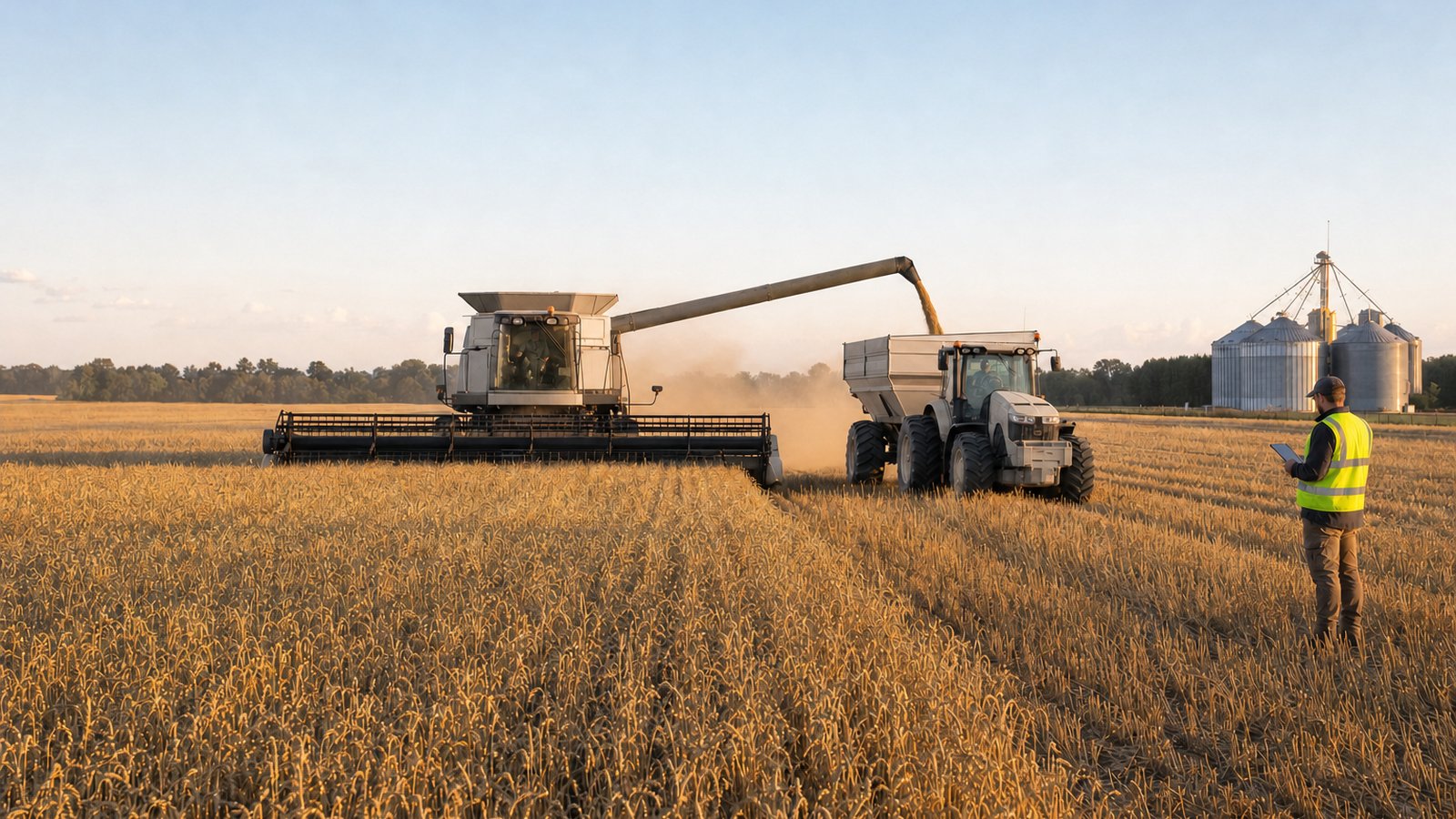
Agriculture adds a constraint most industries do not share: the business calendar is set by the growing season. An update that alters how a grain contract prices a delivery, how a batch is traced, or how a member payment is calculated causes the most damage when it surfaces during harvest intake or spring input sales, which are exactly the weeks when operational teams have the least time to test. Untested Dynamics 365 updates in agriculture therefore carry a seasonal risk profile that a generic testing approach does not address.
Regulatory pressure is rising at the same time. Traceability rules in the United States and the European Union are tightening, cyberattacks on food and agriculture companies are increasing, and recall costs depend heavily on how precisely a business can identify affected lots. This is where finance, operations, and compliance leadership share the same exposure, because each of these risks runs through data and processes that a D365 update can change.
Key Takeaways for Agribusiness Leadership
- Dynamics 365 updates in agriculture should be validated against the operating calendar, because the most costly failures are those that surface during harvest intake, input sales, or member settlement periods.
- Traceability is a regulatory obligation and a cost control at the same time: an update that weakens batch or lot data can turn a narrow recall into a broad and far more expensive one.
- Repeatable, automated regression testing owned by the people who run grain, feed, and settlement processes produces the evidence auditors, regulators, and cooperative members expect.
Why Dynamics 365 Updates Carry Unique Risk in Agribusiness
Agricultural ERP processes combine financial complexity with physical variability. A single grain delivery can involve a contract price, a basis or market adjustment, moisture and protein deductions, drying and storage charges, and a member account, all calculated automatically. If an update changes rounding, pricing logic, or the way quality results flow into settlement, every delivery during harvest is affected before anyone notices that payments are wrong.
Many agribusinesses also operate as cooperatives or multi-company groups. Member payments, patronage distributions, intercompany trading between feed mills, retail outlets, and machinery dealerships, and consolidated reporting all depend on processes that span legal entities. A defect in one entity's configuration can ripple into member statements and group accounts, which raises the stakes for member trust as well as financial accuracy.
Timing compounds the problem. Microsoft's update windows do not move for the harvest, and the operational staff who understand intake, pricing, and settlement are fully committed during peak weeks. When regression testing depends on those same people working through manual scripts, coverage shrinks at precisely the moment the business can least absorb a failure.
Traceability Rules and the Regulatory Calendar
Traceability requirements are expanding on both sides of the Atlantic, and most of the records they demand are created or stored in ERP systems. Three developments are particularly relevant for agribusinesses running D365:
- FDA Food Traceability Rule (FSMA 204). The rule requires businesses that manufacture, process, pack, or hold foods on the Food Traceability List to keep additional traceability records. According to the FDA, the compliance date has moved to July 20, 2028, and Congress has directed the agency not to enforce the rule before that date. The requirements themselves have not changed.
- EU Deforestation Regulation (EUDR). Products derived from cattle, cocoa, coffee, palm oil, rubber, soy, and wood must be shown to be deforestation-free and legally produced. The European Commission confirms that large operators must comply from December 30, 2026, with micro and small enterprises following on June 30, 2027.
- EU General Food Law. Food and feed businesses in the EU have long been required to identify their immediate suppliers and customers, the one-step-back, one-step-forward principle that depends on accurate batch and shipment records.
Each of these obligations relies on lot numbers, origin data, supplier records, and shipment histories remaining accurate after every system change. A Dynamics 365 update that alters batch attribute handling, inventory dimension behavior, or an integration with a quality or sustainability platform can leave records incomplete without generating any visible error. From a governance perspective, validating traceability data after each update is part of meeting these rules, alongside the rules themselves.
What Independent Research Shows About Recall and Cyber Risk
Independent research quantifies what imprecise traceability costs. A 2025 peer-reviewed study in the Journal of Food Protection estimated the costs firms incur when a recall is broader than it needs to be, which typically happens when the source of a problem is misidentified or cannot be identified quickly. Median costs per recall ranged from $3.0 million to $72.7 million for producers, depending on firm size, with additional costs for shippers, distributors, and retailers. The authors note that these figures help quantify the value of traceability in avoiding overly broad recalls.
The implication for agribusiness ERP is direct. When lot and shipment records are reliable, a business can narrow a recall to the affected batches. When an untested update has quietly broken part of that record, the business may have no choice but to recall far more product than the problem requires.
Cyber risk adds a second pressure. Food and Ag-ISAC's 2026 State of the Threat report, as reported by AgFunderNews, recorded 227 ransomware incidents against the food and agriculture sector through July 2026, a 62 percent increase from the 140 recorded in the same period of 2025. Staying current with vendor updates is a basic security control, and organizations that defer Dynamics 365 updates because validation takes too long extend their exposure to known vulnerabilities. Faster, reliable testing therefore supports security as well as operational continuity.
Where Updates Create Risk in Agricultural Operations
Regression testing in agriculture is most effective when it is organized around the processes where an undetected defect affects members, regulators, or the balance sheet. The table below maps those processes against typical update exposure, the business consequence of a defect, and the testing focus each one requires.
| Process Area | Typical Update Exposure | Business or Compliance Consequence | Regression Testing Focus |
|---|---|---|---|
| Commodity contracts and pricing | Changes to pricing logic, rounding, or price adjustment rules | Incorrect payments to growers and disputes during harvest | Contract scenarios across price types, adjustments, and deductions |
| Harvest intake and quality settlement | Changes to weighbridge integrations or quality attribute handling | Moisture, protein, or grade deductions applied incorrectly at volume | End-to-end intake from ticket to settlement under peak volumes |
| Batch and lot traceability | Changes to batch attributes, inventory dimensions, or integrations | Incomplete records under FSMA 204, EUDR, or EU food law, and broader recalls | Forward and backward trace queries on representative batches |
| Member and cooperative accounting | Changes to settlement, patronage, or intercompany logic | Inaccurate member statements and loss of member trust | Member payment runs and intercompany postings across entities |
| Inputs, feed, and seasonal sales | Changes to pricing, credit, or prepayment processes | Order errors and credit exposure during peak input season | Order-to-cash with seasonal pricing, prepayments, and credit checks |
| Financial close and reporting | Changes to posting profiles or consolidation | Misstated results and audit findings | Period close, consolidation, and key financial reports |
Organizations that manage this well tend to follow a consistent rhythm through the agricultural year:
1. Map critical processes to the season. Identify which processes peak in which months, so the heaviest regression coverage runs before those periods.
2. Test traceability as a business process. Include trace queries and recall simulations in every regression cycle, alongside financial and operational scenarios.
3. Let process owners own the scenarios. Grain, feed, and settlement experts recognize a wrong result faster than technical testers, so they should define what correct looks like.
4. Retain dated evidence for every release. Keep a record of what was tested, against which update, and with what result, so auditors, regulators, and members can see that controls held.
How Elevaite365 Supports D365 Test Automation in Agriculture
The practical constraint for most agribusinesses is capacity, because the people who understand intake, pricing, and settlement are also the people running the business through each season. Elevaite365 Test Automation allows those process owners to build tests without code, either by recording a process as it is performed or by importing existing Task Recorder files and Regression Suite Automation Tool (RSAT) scripts.
Because agricultural processes often span several applications, tests can follow a scenario across Dynamics 365 and connected web applications in a single run. Scheduled runs allow full regression passes to complete overnight in sandbox environments ahead of each update, and self-repair keeps tests usable as screens change between releases.
Every run produces step-level evidence, including screenshots and a video of the execution, with results that can be exported to PDF or Word for audit and compliance files.
Organizations that prefer to hand update validation to a partner can do so through WaveReady, and teams assessing the investment can model their current manual testing effort with the Elevaite365 ROI calculator.
Conclusion: Update Validation as Part of the Agricultural Calendar
The risks of untested Dynamics 365 updates in agriculture are shaped by the season, by traceability obligations, and by the trust of growers and cooperative members. Microsoft's update cadence will continue, the EU Deforestation Regulation and the FDA Food Traceability Rule will keep raising expectations for record accuracy, and the threat environment for food and agriculture companies is intensifying.
Agribusinesses that plan update validation around the agricultural year, test traceability as rigorously as finance, and retain evidence for every release will be better placed to absorb that cadence without disrupting harvest or member payments. A practical first step is to list the processes that peak in the next season and confirm how many of them are validated, automatically and with evidence, before each update reaches production.
Frequently Asked Questions
Why is testing Dynamics 365 updates different for agricultural businesses?
Agricultural operations peak around planting and harvest, and the processes that run during those weeks, such as intake, quality settlement, and member payments, are both high-volume and time-critical. A defect that would be a minor inconvenience in a quiet month can affect thousands of transactions during harvest.
Testing therefore needs to be planned around the operating calendar, with the most thorough regression coverage completed before peak periods. Automation makes that practical, because full regression runs no longer depend on the availability of staff who are busy running the season.
How do D365 updates affect traceability compliance?
Updates can change how batch attributes, inventory dimensions, and integrations handle the data that traceability rules depend on. If those records become incomplete, a business may fall short of FSMA 204, EUDR, or EU food law requirements without any visible system error.
Including forward and backward trace queries in every regression cycle confirms that lot, origin, and shipment data remain intact after each update. The resulting test records also show regulators and auditors that traceability controls were checked after system changes.
Which agricultural processes should be tested first?
Start with commodity contracts and pricing, harvest intake and quality settlement, batch traceability, and member or cooperative accounting. These carry the highest combination of financial, regulatory, and relationship risk.
Input and feed sales, seasonal credit processes, and the financial close follow closely. Prioritizing by both risk and season ensures the most important scenarios are covered before the periods when a failure would do the most damage.
Can agribusinesses keep their existing RSAT scripts?
Yes. RSAT scripts can be imported into Elevaite365 Test Automation and made ready to run after a short review, so existing coverage is carried forward rather than rebuilt from scratch.
This matters because Microsoft will end support for RSAT in 2027. Importing tests also gives organizations a chance to extend coverage beyond what RSAT handled, including end-to-end processes that cross into connected applications.
Who should own update testing in an agricultural organization?
The people who run grain, feed, inputs, and settlement processes should own the test scenarios, with IT coordinating environments and finance and compliance defining the evidence they need. Process owners recognize an incorrect result faster than anyone else.
This model works when building and maintaining tests does not require coding skills or weeks away from daily work. No-code test creation and scheduled, unattended runs let process owners keep coverage current, even during busy seasons.
Elevaite365 is a Microsoft-focused solutions provider specializing in test automation for Dynamics 365 applications. Learn more at elevaite365.com.
A Note on Statistics Used in This Article
1. The recall cost figures (median costs per overly broad recall of $3.0 million to $72.7 million for producers, depending on firm size) are from Ackerley et al., "Costs of Overly Broad Recalls," Journal of Food Protection, volume 88, issue 3, published February 2025. The study is peer-reviewed and uses structured expert elicitation to estimate per-firm costs of recalls that extend beyond affected product.
2. The ransomware figures (227 incidents against the food and agriculture sector through July 2026, a 62 percent increase from 140 in the same period of 2025) are from the Food and Ag-ISAC 2026 State of the Threat report, as reported by AgFunderNews on October 22, 2026. The Food and Ag-ISAC is a nonprofit threat-intelligence organization for the food and agriculture sector.
3. The regulatory dates for the FDA Food Traceability Rule and the EU Deforestation Regulation are taken directly from the FDA and the European Commission, as current in November 2026.

Aline Andersson
Global Marketing Manager
Based in Stockholm, Aline leads global marketing at elevaite365. She brings a strategic background in product marketing and communications across B2B technology, healthcare, and enterprise data platforms, with particular strength in positioning complex, AI-enhanced solutions for regulated industries.